- The Peel
- Posts
- Stocks Ignore Oil Spike
Stocks Ignore Oil Spike
Oil resumed its climb, but U.S. stocks stayed relatively steady this time.

Your Daily Dose of Market & Career Clarity
📬 Delivered to 150,000+ ambitious readers
Silver banana goes to…

Get a Top Job Offer, Guaranteed (or tuition is free) | Apply Here
Market Snapshot
📉 Banana Bits
Oil resumed its climb, but U.S. stocks stayed relatively steady this time.
Mortgage rates ticked up, with 30-year loans reaching 6.35%.
The FTSE 100 rose, led by energy and bank stocks ahead of the BoE decision.
Central banks are tightening again as the energy shock ripples globally.
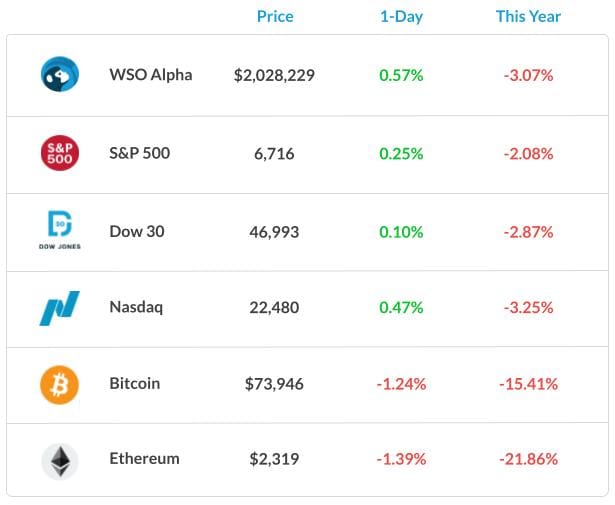
U.S. markets edged higher, with oil holding above $103 amid ongoing Iran tensions.
Market News
S&P Up, World on Fire (Again)
Global financial markets were volatile today as investors reacted to ongoing geopolitical tensions and rising energy prices. U.S. stocks finished mixed but showed resilience, with the S&P 500 rising about 0.2–0.3% despite recent volatility.
Oil prices remained high above $100 per barrel, driven by concerns about supply disruptions in the Middle East. Higher energy costs raised fears about inflation, as they can increase expenses for both businesses and consumers.
Overall, investor sentiment remained cautious but slightly optimistic given the market’s ability to rise despite macro uncertainty.

Market trends showed clear divergence across sectors and regions. Energy and financial stocks led gains, helping support the broader S&P 500, which was supported mainly by energy and financial stocks. Meanwhile, airlines and transportation companies faced pressure from higher fuel costs.
Global markets were mixed, with some international indexes posting gains amid elevated oil prices and continued volatility. Volatility stayed elevated, with markets reacting quickly to geopolitical headlines. Looking ahead, the S&P 500’s performance will likely continue to depend on energy prices and developments in global geopolitical risk.
Peel Take: Markets are holding up despite surging oil and geopolitical chaos, but the resilience feels fragile as energy prices keep driving the narrative.
What's Ripe
Delta Air Lines (DAL) 6.6%
Shares rose around 6.6% after the company reported strong travel demand for early 2026 and robust forward bookings, reinforcing its positive financial outlook.
The updated outlook suggests consumers are still willing to spend on travel despite higher costs, easing concerns that rising fuel prices and macro uncertainty would dent demand.
Peel Take: Turns out people are still booking flights like nothing’s wrong, giving Delta a nice lift. Higher prices? Geopolitics? Apparently, not enough to stop vacation plans.
Micron Technology (MU) 4.5%
Stock gained as investors expect strong earnings driven by high demand for its high-bandwidth memory (HBM) chips, which are critical components in artificial intelligence (AI) data centers.
Strength across the broader semiconductor sector also supported the move, as optimism around data centers and AI infrastructure spending continues to lift chipmakers.
Peel Take: As long as AI keeps eating up memory chips like snacks, Micron stays winning. Right now, the AI boom is doing most of the heavy lifting.
What's Rotten
Eli Lilly (LLY) 5.9%
Shares dropped by 5.9% after HSBC downgraded the stock, citing valuation concerns and overly optimistic growth expectations, hurting investor sentiment.
Investors also grew cautious about whether future growth can justify current pricing levels, leading to a pullback in sentiment.
Peel Take: When expectations get a little too ambitious, reality tends to show up uninvited. A downgrade was all it took for investors to rethink the hype.
Cencora (COR) 3.2%
Stock declined following a leadership transition (CFO change). They announced that CFO and Executive VP James Cleary will retire on June 30, 2026, creating uncertainty. Investors reacted negatively to potential disruption in financial strategy and execution.
The shift raised concerns about potential disruption in financial strategy and execution, prompting investors to take a more cautious stance in the near term.
Peel Take: A CFO exit might not sound dramatic, but markets hate uncertainty, especially when it comes to who’s handling the money.
🧠 Technical Trip
Interview Q&A from Morgan Stanley

👉 Want 1-on-1 recruiting help from Morgan Stanley bankers & 2,000+ top mentors? Apply to WSO Academy
📚 Lesson from the Library
🎥 Advanced Accounting: Mastering the Real Numbers Behind the Deals
Go beyond basics — learn deferred taxes, NOLs, stock compensation, and complex accounting used in real-world models.

🌟 WSO Academy Q4 Update
🧠 Improved Mentor Preparation Before Sessions
We’ve also upgraded the system to give mentors more context about the student’s background + prior sessions. Ultimately, equipping them with all the information they need about them before their session begins.
Mentors now have easier access to:
Notes and feedback from the student’s previous sessions
Student’s progress within the program
Student’s recruiting goals and timeline
This allows mentors to pick up right where the previous session left off and give more targeted advice during each call.
🦈 Deal Dispatch
M&A, IPOs, And Other Notable Transactions
Mastercard is acquiring stablecoin startup BVNK in a deal worth up to $1.8B.
An alternative asset manager placed a $53M bet on Manning & Napier.
RIA M&A activity crossed a dozen transactions in early March.
Fulgent Genetics completed its acquisition of Bako Diagnostics and StrataDx.
Mercantile Bank was recognized for the top M&A deal of the year in finance and banking.
📊The Daily Poll
Raising rates during an energy shock is |
Previous Poll:
If chip shortages last till 2030, who benefits most?
Chip makers: 50.0% // Big Tech: 19.3% // Governments: 6.8% // Suppliers: 23.9%

Banana Brain Teaser
Previous
For the positive integers a, b, and k, (a)^k || b means that (a)^k is a divisor of b, but (a)^k+1 is not a divisor of b. If k is a positive integer and (2)^k || 72, then k is equal to?
Answer: 3
Today
Each year for 4 years, a farmer increased the number of trees in a certain orchard by 1/4 of the number of trees in the orchard the preceding year. If all of the trees thrived and there were 6,250 trees in the orchard at the end of the 4-year period, how many trees were in the orchard at the beginning of the 4-year period?
The big money in real estate is not in the buying and selling, but in the waiting.
How Would You Rate Today's Peel?
Happy Investing,
Chris, Vyom, Ankit, Mitchell, Fernanda, & Patrick